




Lesson Overview
The main aim of the lesson is to help learners understand and confidently use personality adjectives with negative prefixes to describe people and their behaviour. By the end of the lesson, students are able to recognise, form, and use common negative adjectives (e.g. dishonest, impolite, unreliable) in meaningful contexts, and apply them when talking about real-life situations, relationships, and personal experiences.
Lead-in & Engagement
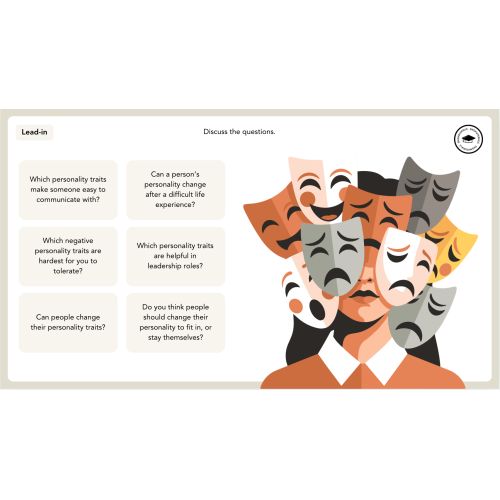
The lesson begins with a discussion-based lead-in that activates learners’ prior knowledge about personality and behaviour. Students share opinions and experiences, which creates emotional engagement and prepares them to talk about people in real life.
Contextualised Input
Target vocabulary is introduced through short, realistic situations where behaviour clearly shows meaning. This helps students understand adjectives through actions and context, rather than translation alone.
Guided Discovery of Grammar
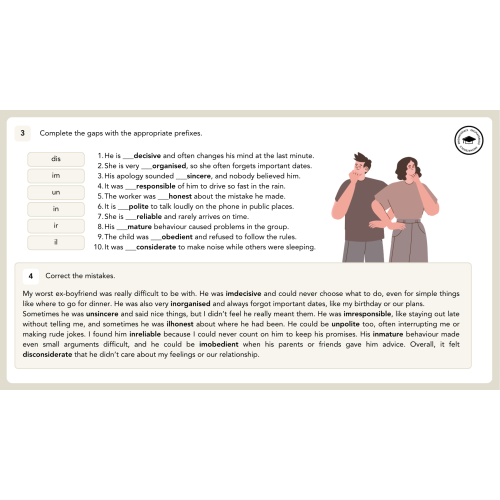
Students notice and explore negative prefixes through examples, supporting awareness of word formation. Rules are clarified after exposure, encouraging deeper understanding and retention.
Controlled Practice
A variety of structured tasks (matching, gap-fills, error correction) support accurate use of new vocabulary and prefixes, while keeping the cognitive load appropriate for A1–A2 learners.
Recycling & Awareness of Meaning
Previously learned adjectives are recycled in new negative forms, helping students see contrasts and strengthen lexical memory through comparison (e.g. honest → dishonest).
Personalisation & Speaking
Learners apply the language to their own lives through discussion questions and conditional situations (If someone was unreliable…), increasing motivation, fluency, and confidence.
Reflection & Social Awareness
The lesson ends with reflection activities that encourage students to think about behaviour, relationships, and consequences, supporting both language development and emotional intelligence.
January 24, 2026